
You are not alone: Brand Complexity is the new normal.

You are not alone: Brand complexity is the new normal.
Every brand swears its complexity is one of a kind. «No one else has to juggle this mix of subbrands, markets, and audiences,» leadership insists. But here’s the truth: Mergers and acquisitions, new regional markets, digital channels and product expansions have made complexity the standard condition of brand leadership today. What feels like an exception is, in fact, a mass phenomenon. And that is good news. Because if complexity is the norm, we can stop treating it as a problem to be feared and start treating it as a reality to be managed—and even used to our advantage.
The Reality: Brands Are Grown, Not Engineered
Most brand architectures were not designed on a clean sheet of paper. They have been layered and adapted over years—shaped by acquisitions, local market needs, fast-moving product launches and internal politics. The result is a patchwork: sometimes a Branded House, sometimes Endorsed Brands, sometimes a House of Brands—often all at once.
At the same time, target groups have multiplied. Decision makers, end users, gatekeepers, multipliers, critics—each with their own expectations. And they exist on different levels: corporate, subbrand, and product. Here lies the dilemma: audiences are becoming more specific and fragmented, while markets are becoming larger and more complex. The tension is inevitable.
Key questions every brand faces:
- How autonomous should subbrands appear?
- How visible should the parent brand remain in tone, design and sender?
- Where do inconsistencies in perception arise?
From this reality emerge the same recurring conflicts across almost every organization:
- Subbrand autonomy vs. parent brand cohesion
- Global narrative vs. local relevance
- Short-term sales pressure vs. long-term brand consistency
These are not anomalies—they are the permanent state of play. And the challenge is not to wish them away, but to find the right mechanism to balance them.
The Missing Lever
Most companies respond structurally. They redraw architecture charts, refine subbrand models, or segment audiences in ever greater detail. These steps matter—but they remain formal solutions to a semantic problem. What’s often missing is the narrative layer. Storytelling is an overlooked lever with the power to turn complexity into coherence:
- It provides the overarching frame from which sub-frames can be derived.
- It transforms the smallest common denominator into the largest shared meaning.
- It ensures that architecture and guidelines are not just rules, but expressions of purpose.
Without this semantic foundation, brand structures remain diagrams. With it, they become a living system.
How Storytelling Creates Coherence
The practical approach is clear:
- Define the core narrative.
Not what the logo looks like, but what the brand stands for at its essence. - Translate it into a narrative framework.
Subbrands and local teams need freedom, but also a common language and orientation. - Adapt without losing the thread.
A strong story is not a straightjacket. It is a backbone that allows multiple expressions without losing integrity.
The result: complexity remains, but it becomes intelligible, meaningful and even advantageous.
But Storytelling is never just words on a page. It is the shared mantra, the common drive that runs through every expression of a brand. In language and tone, in emotions and images, in typography and design systems—the story shows up everywhere. A strong story does not erase difference; it gives difference a framework. Design does not flatten expression; it enables recognizability across variation. That’s why the specific structural choices matter less than the consistency of meaning behind them. Whether a brand leans toward a Branded House or a House of Brands, what counts is that the same underlying narrative holds it together.
The Greatest Common Denominator
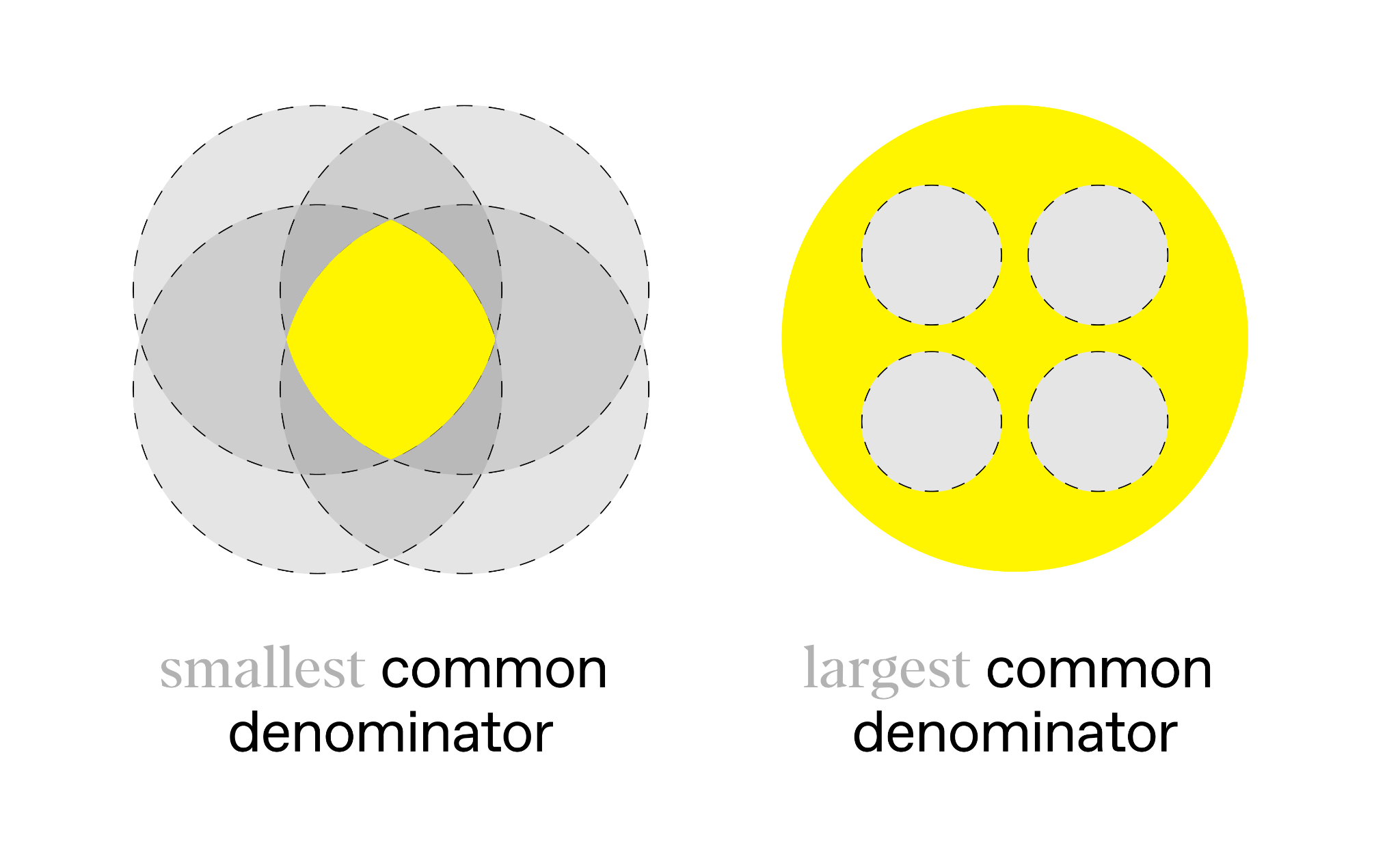
When brands face complexity, the instinct is almost always the same: «Let’s reduce it. Let’s find the smallest common denominator.»
The goal: aligning all subbrands and target groups by stripping everything down to what they all share. In theory, it creates clarity. In practice, it often creates emptiness. What remains is so minimal, so generic, that it inspires nobody. We’ve learned: Brands that tiptoe around everyone end up connecting with no one at all.

And it’s the same with people. At one point or another, we’ve all thought: «If I just found the right job, or lived in the right place, I’d be different.» And yes, circumstances can influence how we feel. A sunnier climate might draw us outside more often, boost our endorphins, and lift our mood. But the deeper truth is this: we take ourselves everywhere we go. Our strengths, our flaws, our quirks—confidence or indecision, resilience or doubt—they travel with us. It’s not the environment that ultimately defines us, it’s our identity.
And here’s the catch: when we adapt too much to every room we enter, we don’t just lose a bit of ourselves. We risk losing all distinctiveness. We become unremarkable and eventually, forgettable.
That’s why, at CRU, we aim for the opposite: the greatest possible common denominator. Not the lowest common ground where nothing collides, but the highest shared meaning that actually connects. And when that meaning is clear, it doesn’t just build coherence—it drives sales. Because people buy into stories they understand and want to be part of. And sales teams do too: a clear story is simple to tell, and easy to sell.

In our projects we see this pattern again and again: once the story is in place, even highly autonomous subbrands can pull in the same direction. The energy no longer goes into negotiating rules, but into amplifying meaning. And that makes the brand stronger, not smaller.
This all sounds smart in theory, but also hard to grasp. So, let’s make it tangible: Take ‹Apple›. Whenever we ask clients which brands stand out to them, Apple almost always makes the list. And it’s not because they love silver and white. Or apples. It’s because Apple makes complexity feel simple—and memorable.
On paper, its portfolio is extensive: laptops for professionals, phones for everyone, wearables for health, services for entertainment, and entire ecosystems for developers. Structurally, it could look messy. Not everything even carries the Apple name: There are several iThings, some AirThings and Beats—even entire services that play by different naming rules. By traditional architecture standards, this is inconsistent, even confusing. And yet, it never feels that way. Why? Because everything Apple does is tied together by a single story: technology designed to empower creativity through simplicity. Typography, materials, keynotes, interfaces, product ecosystems—everything follows the same principles. The effect: the architecture becomes secondary. Whether you pick up an AirPod, log into iCloud, or open a MacBook, you experience the same identity. You don’t just buy a device, you buy into a worldview. Apple doesn’t minimize complexity. It transforms it into coherence—through story, design, and experience.
Conclusion: From Fragments to an Identity
Complexity in brand architecture is no longer an exception; it is the rule. Managing it only through structures and schematics leaves organizations stuck at the surface. The real task is deeper: to turn fragments into a story. When storytelling becomes the guiding lever, complexity is no longer a burden. It becomes the foundation for a brand that can act globally, resonate locally and remain coherent across audiences.
We have learned that the brands who thrive are not those who minimize themselves down to the smallest common denominator. They are the ones who dare to define the greatest possible one. Because brand leadership today is not about eliminating complexity. It’s about mastering it through meaning.
.gif)


